
Over the years, I have come across many students who perform well in some subjects, but struggle in others. One such student was a bright 12-year-old who loved football, Math and Science. Yet History and English seemed to tell a different story.
His parents were understandably puzzled.
“If he can do so well in Maths and Science, why is History and English such a struggle?”
Like many parents, they decided to arrange subject tutoring in History and English.
There is certainly a place for subject tutoring. Many students benefit from it. A subject tutor is, above all, an expert in the subject itself—the subject content, what makes a strong answer, what scores well and other examination requirements. Their goal is to help students understand the material, build confidence and improve performance in that particular subject. For many students, this is exactly the right support.
However, in my work with students, I found myself asking a different question.
Was the difficulty really in the subject?
Often, what looks like a subject problem is actually an underlying difficulty with the skills needed for learning. It simply becomes more noticeable in certain subjects.
Maths and Science suited this student’s strengths. He enjoyed recognising patterns, solving problems and learning by doing. History and English, however, demanded something different. They required him to read for longer periods, hold several ideas in mind at the same time, organise information, plan his thoughts before writing and express his understanding clearly.
If a student finds these underlying skills challenging, some subjects will naturally feel much harder than others. That does not mean the student is any less capable. It simply means they may need support to develop the skills that successful learning depends on.
This is where the difference between subject tutoring and learning support begins to matter.
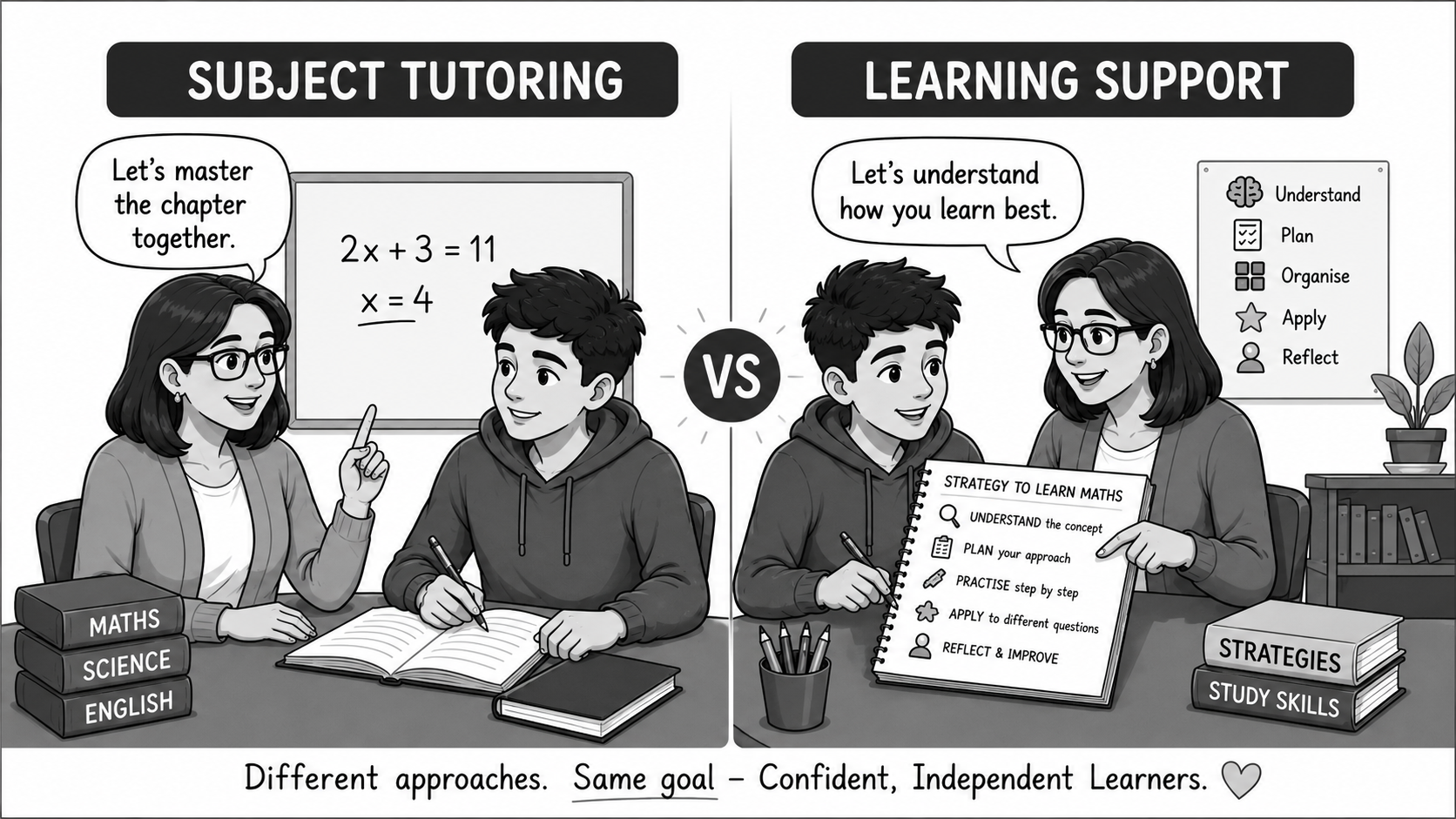
While subject tutoring focuses on what a student is learning, learning support focuses on how a student learns.
Learning support looks beyond the curriculum to understand what may be making learning difficult in the first place. Sometimes the underlying challenge may be related to reading, written expression, executive functioning skills such as organisation, planning or time management, or a learning difference such as dyslexia or dysgraphia.
Once these underlying difficulties are understood, teaching can be adapted to the student’s learning profile. Resources can be personalised, strategies can be taught and confidence can gradually be rebuilt. As these skills develop, the benefits are often seen not just in one subject, but across the curriculum.
Subject tutoring and learning support are both valuable. One is not a replacement for the other. The important thing is understanding what the student truly needs.
If the challenge lies in understanding a particular subject, subject tutoring may be exactly the right choice.
But if similar difficulties appear across different subjects, or if the student knows the answers but struggles to read, organise, plan or express them, it may be worth looking beyond the subject itself.
Instead of asking “Which subject is my child struggling with?” perhaps we should ask, “What is making learning difficult for my child?”
Very often, the answer to that question is the first step towards providing the right kind of support.
Was the difficulty really in the subject?
Often, what looks like a subject problem is actually a learning skills problem that becomes more noticeable in certain subjects.
Maths and Science suited the way this student learned best. He enjoyed recognising patterns, solving problems and learning by doing. History and English, however, demanded something different. They required him to read for longer periods, hold several ideas in mind at the same time, organise information, plan his thoughts before writing and express his understanding clearly.
If a student finds these underlying skills challenging, some subjects will naturally feel much harder than others. That does not mean the student is any less capable. It simply means they may need support to develop the skills that successful learning depends on.
This is where the difference between subject tutoring and learning support begins to matter.
While subject tutoring focuses on what a student is learning, learning support focuses on how a student learns.
Learning support looks beyond the curriculum to understand what may be making learning difficult in the first place. Sometimes the underlying challenge may be related to reading, written expression, executive functioning skills such as organisation, planning, time management or a learning difference such as dyslexia or dysgraphia.
Once these underlying difficulties are understood, teaching can be adapted to the student’s learning profile. Resources can be personalised, strategies can be taught and confidence can gradually be rebuilt. As these skills develop, the benefits are often seen not just in one subject, but across the curriculum.
Subject tutoring and learning support are both valuable. One is not a replacement for the other. The important thing is understanding what the student truly needs.
If the challenge lies in understanding a particular subject, subject tutoring may be exactly the right choice.
But if similar difficulties appear across different subjects, or if the student knows the answers but struggles to read, organise, plan or express them, it may be worth looking beyond the subject itself.
Instead of asking, “Which subject is my child struggling with? “perhaps we should ask, “What is making learning difficult for my child?”
Very often, the answer to that question is the first step towards providing the right kind of support.
About the Author
Resmi Sreekumar is the Founder of EdInclusia and a Learning Support Specialist with over two decades of experience supporting
diverse learners across international school settings. Through her blogs, she shares practical insights on learning, learning support and inclusive education for students, parents, educators and schools.